












One of the beautiful things associated with green energy initiatives is the development and use of new technologies. Green energy ventures encourage the creation of new industries, and offshore wind projects are one of those industries taking the country into a promising future of cleaner, less costly energy. New York City is fortunate enough to have its own such project, just 20 miles south of Far Rockaway in the New York Bight, the stretch of ocean making a triangular shape between Long Island and New Jersey.

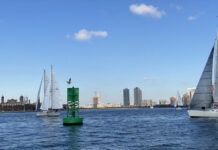
A flotilla of sophisticated equipment and watercraft have been busy at work, not only in the Bight, but also in the Verrazzano Narrows and New York Harbor. The Norwegian firm Equinor’s Empire Wind will be a 54 turbine wind farm capable of generating 810 megawatts of clean power to over a half million New York City homes achieved through the newly created South Brooklyn Marine Terminal (SBMT) port in Sunset Park, Brooklyn.
Equinor’s Empire Wind is one of five individual offshore wind farm projects along the East Coast presently in development or under construction in Rhode Island, Virginia, Massachusetts and New York. Various state and federal agencies such as the EPA, NOAA Fisheries, Department of the Interior, Bureau of Ocean Energy Management (BOEM), and U.S. Coast Guard must sign off on the developer’s plans for construction before the lease area is awarded to the winning bidder. In 2019, New York Harbor Channel participated in the Empire Wind forum when New York State Energy Research and Development Authority (NYSERDA) met where the South Brooklyn Marine Terminal is currently located. NYSERDA and Equinor were responsible for performing site studies and environmental impact research to qualify for the bidding process.

EMPIRE WIND 1 IS MORE THAN 60% COMPLETE
In 2024, Equinor began construction on three separate stages of installation: establishment of the rock foundations supporting each of the 54 monopile turbine towers, creation of the substation in the Bight, and laying of the export transmission cables that run from the Bight, under the Verrazzano Bridge, through New York Harbor, to the SBMT port. Equinor, with support from suppliers, has installed several offshore wind farm projects around the globe over the past decade and now is providing their technology and talent here in the waters of New York.

The operational wind farms on the East Coast are the South Fork Wind off Long Island, the Vineyard Wind off Massachusetts, and Block Island off Rhode Island.

The wind farm installation zone is noticeably “eco-friendly”, meaning minimized CO2 emissions on site. The cranes, hoists, pile drivers, generators, air compressors, motors, bilge pumps and cooking stoves are using alternative energy power such as battery and solar. Internationally, offshore installations must be compliant with environmental air and water pollution concerns as well as with marine fish and mammal protections. The South Brooklyn Marine Terminal is designated a low-emissions hub and its infrastructure contains solar power charging stations for service vessels.

Photo: Edison Chouest / Equinor
Eco Liberty, the newest service operations vessel (SOV), launched from New Orleans in June 2025 with the Empire Wind logo freshly emblazoned on its hull. SOVs are specialized ships that act as a mobile base and a floating hotel for the workers building and maintaining the offshore wind farm. Union workers from the dock builders, electrical workers, iron workers and operating engineers, are living on the vessel as they lay cable and hook up the offshore substation. It should be noted that ECO Liberty, like many offshore wind support vessels, are hybrid and still rely on traditional fuel when not stationary in the construction zone.

Last fall, at least two cable-laying vessels were spotted performing work along the Brooklyn shoreline. Living Stone, a cable-laying vessel from DEME, a firm based in the Netherlands, provides crane capacity for rock-moving or trenching. Onboard operations are powered by solar panels and above deck wind turbines. The other vessel, the Marmac, was built in Louisiana by the Nexans Norway firm. The 300-foot barge was working in New York Harbor.


Thialf, the semi-submersible crane vessel used globally, was previously at the windfarm site. The vessel is operated by Heerema Marine Contractors of the Netherlands, and was used for the installation of 54 monopiles and transition pieces.
BUBBLE CURTAIN TECHNOLOGY ARRIVES
The ship Tidewater Polaris was deployed to assist with the bubble curtain used during the foundation work and pile-driving phases. Owned by Thayer Mahan of Groton, Connecticut, specialists in offshore underwater air bubble technology needed for noise mitigation, the Tidewater Polaris is fitted with a giant spool that reels out a reinforced rubber hose roughly 5 inches in diameter and configured with an array of holes.

The ship circumnavigates a construction platform approximately 500 feet from the monopile in a perfect circle. The closed circuit hose is connected to the series of onboard air compressors to create the forced, double air bubble curtain. The bubble system is known to significantly reduce noise pollution and was mandated to reduce disturbing sound waves from traveling outside the construction zone. The physics underlying bubble curtain technology involves changes in water density causing sound waves to be trapped within the bubble curtain. Tests have proven the technology works very effectively. Around the world, offshore projects report whale migration and birthrates have been undisturbed, with similar results for other marine mammals like seals, sharks and dolphins.


Minutes before the pile driving begins, the air bubble curtain is activated. Protected Species Observers, certified by NOAA, use multi-science monitoring devices employed miles away, to record sound levels of the construction machinery. In collaboration, passive acoustic monitoring is implemented by marine scientists and may include fish and marine mammal tagging to determine seasonal behavior. A variety of agencies, including Woods Hole Oceanographic Institute, already have permanent buoy devices in the New York Bight and along the eastern U.S. coastline. Popular whale-tracking technology is available on apps indicating the presence of specific species based on their vocalizations. With monitoring in place, the pile driving commences.
The U.S. Coast Guard maintains a 500-meter safety zone to deter ship strikes to equipment as well as for the protection of marine mammals. Additionally, Equinor shuts down operations in compliance with a mandatory restriction period for mammal migration. Whales, especially the endangered North Atlantic Right whales, pass through the Hudson Canyon and the New York Bight. Thus, an agreed-upon moratorium on heavy construction has been established for the migration season between January and the end of April.
EMPIRE WIND CONSTRUCTION IN 2026
Doreen M. Harris, President & CEO of New York State Energy Research and Development Authority (NYSERDA), oversees the working relationship between NYSERDA, Equinor and vendors who employ New Yorkers for the massive offshore wind farm project. Harris expressed appreciation to the turbine and blade manufacturer, Vestas, for their involvement in the project. Materials will be ferried across the Atlantic Ocean to the South Brooklyn Marine Terminal and after assembly, will be barged to the New York Bight and placed atop the 400-foot monopiles. Installation is planned to occur during the second half of 2026.
The Wind Turbine Installation Vessels (WTIV) will be supplied and operated by Maersk, one of the largest marine container operators on the planet. WTIVs are Maersk’s newest maritime investment, along with other large construction offshore wind fabrication support vessels from their Singapore dry docks.
EQUINOR BUILDS COMMUNITY AWARENESS AT WINDSCAPE BROOKLYN CENTER

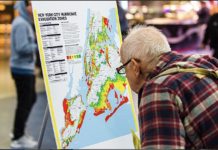
Equinor, in collaboration with NYC, offers schools and local community groups a new home. It has created an interactive learning center at Industry City in the Sunset Park Section of Brooklyn, adjacent to the South Brooklyn Marine Terminal. The learning center has been named WindScape Brooklyn and features exhibits and lectures.
Exhibits describe various methods and materials essential to the success of the offshore wind industry. Serving as an educational hub, WindScape Brooklyn hopes to foster the interest of young adults in renewable energy initiatives. Experts in the marine sciences deployed in the New York Bight offer a hands-on learning experience for all ages.
Just across the hall, is the Offshore Wind Innovation Hub. This New York University program opens startups and loca
Visiting students from New York City Public Schools to WindScape Brooklyn likely represent a number of future marine-focused scientists and surely, generations of concerned citizen scientists.
Worldwide, there is rapidly growing support for the goal of renewable energy. We also must recognize the rea
How wonderful it is that, as Bob Dylan would say, the answer is blowing in the wind…
AD:
Custom progamming, database and system support
Best custom computer programming, database and system work. https://custom-software-usa.com Custom Software USA