









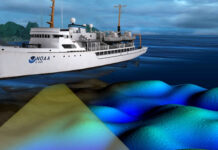
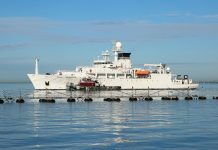


One hundred years ago, an ocean trench greater than the depth and breadth of the Grand Canyon was discovered not far from New York Harbor. The Hudson Canyon remains an underwater wonder visited by only a select few. NOAA recently conducted a webinar that featured live streaming of the Hudson Canyon depths from their robotic rover cameras. The world shared moments of discovery as video captured the sea creatures that thrive in these dark depths. It was a time to celebrate the work of the original team of explorers that comprised the Arcturus Expedition in 1925. The Hudson Canyon awaits approval from the U.S. government to mark it as a National Marine Sanctuary site affording it greater protections from environmental harm. Local divers and fishermen have posted their exploits, but mapping and filming the geologic characteristics of the depth can be achieved by only a few.


And in the 20th century, at a time when photography was available for scientific research, hand drawn illustrations still captured and captivated biological classification and depiction for both science and an audience appreciative of artistic creation. The new frontier was the planet’s deep sea environment. Illustration ruled the waves as underwater photography was not viable for marine explorers. Dr. William Beebe was one such visionary, exploring ocean floors with advanced tethered submersible scientific laboratories. Beebe’s famous bathysphere would follow, to be introduced in 1930. Adherence to a viable and beautiful depiction was in much demand even as the alternative was knocking at the door. Art was still housed proudly in the many societies that lined New York City streets. Philanthropists funding expeditions for the love of culture, history, and science expected illustrations to adorn their walls.

The Arcturus Expedition made headlines in 1925. Hosted and funded by The New York Zoological Society, the predecessor of the Wildlife Conservation Society (now in charge of the Bronx Zoo and the New York Aquarium) provided the vessel to set out for the Pacific Ocean’s Galapagos Islands by way of the Sargasso Sea and the nearby Hudson Canyon in the Atlantic. But before Beebe’s ship left New York Harbor, he made sure six women were on board. All six were scientists he trusted, and he publicly espoused their excellence. Here, one hundred years ago, Isabel Cooper busied herself just a few hours out of the Verrazzano Narrows. These are some of her illustrations drawn from the Arcturus Expedition

New York Harbor Channel will not venture to replicate the excellent work on The Arcturus exploits already posted by such contemporary advocates as Anita Glesta. Her work is currently commissioned by the WCS and available through her website, anitaglesta.com. NOAA’s National Marine Sanctuaries also posted a beautiful presentation on sanctuaries.noaa.gov written by Elizabeth Moore in March,2023. NYHC encourages you to immerse yourself in their content. But please join us as we follow in their footsteps to introduce you to the marine world of events happening today in technological innovation as well as the beauty of the sea creature inhabitants and migrants as well as the recent or archived artistic renderings that constantly pour over our New York Harbor waters.
AD:
Custom progamming, database and system support
Best custom computer programming, database and system work. https://custom-software-usa.com Custom Software USA