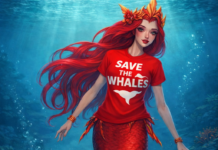












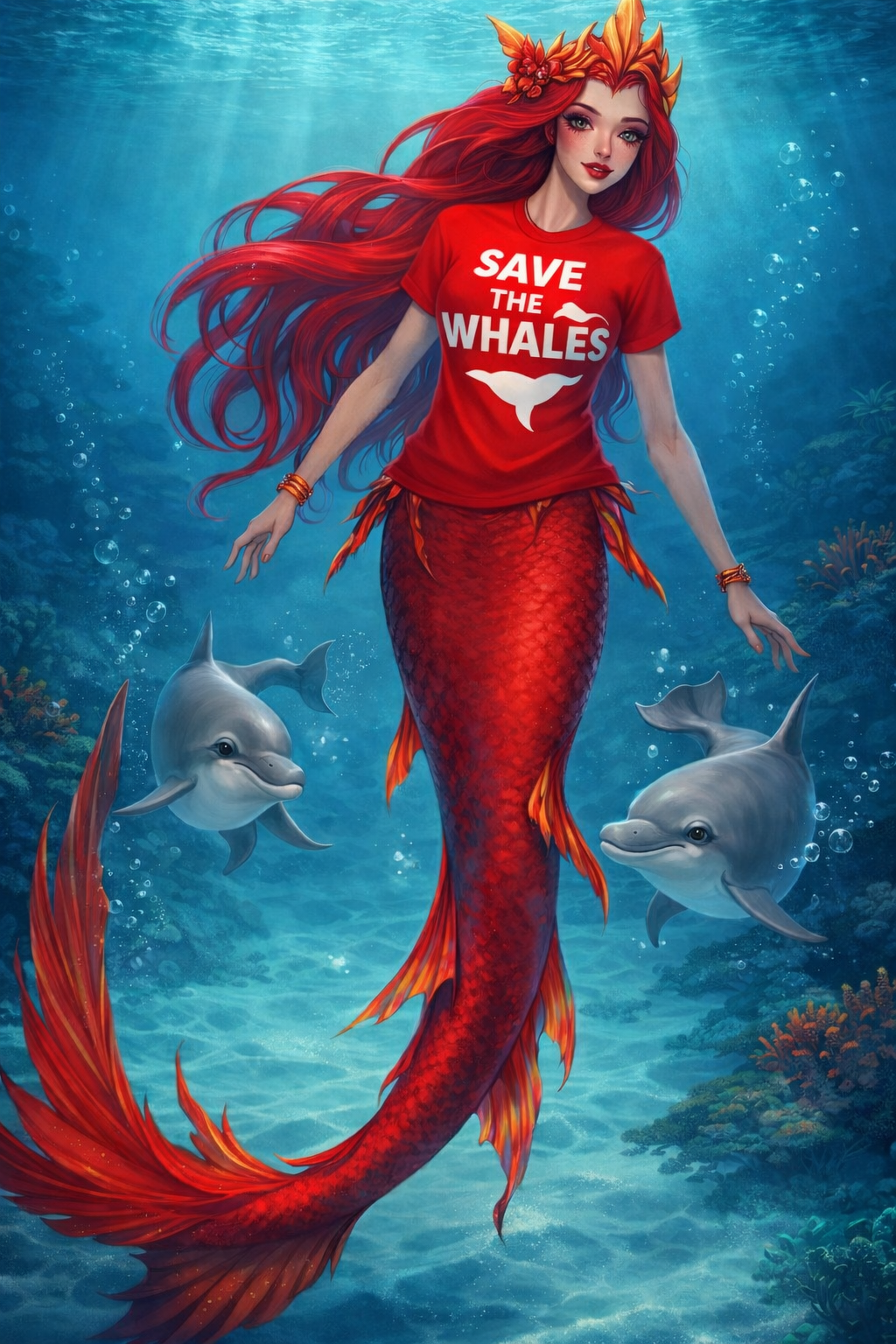
Greetings and welcome! New York Harbor Channel would like to introduce you to Scarlet, the New York Harbor Mermaid. Scarlet lives in the Verrazzano Narrows at the mouth of the harbor. Her four latest journeys create a story about significant issues and endeavors that currently affect New York City marine environs. There is no better expert to guide you through the multifaceted twists and turns of our shoreline than Scarlet! She interacts with every community above and below the New York City waterline, a location representing a microcosm of every city on the planet that has a harbor or inlet.
Scarlet’s animated marine adventures are told through four unique, educational songs and videos. Don’t be surprised when you find yourself singing along! Children everywhere will learn interesting facts about coastal habitats even if they don’t live near the New York Harbor. The Scarlet the New York Harbor Mermaid audio album will be available on all major streaming services August 22nd.
* * * * * * * * * * * * * *
Click open this link to take a deep dive into a sneak peak of the first of the four hidden treasures found in Scarlet’s songbook. Song #1: MANHATTAN MENHADEN
Quick Peek at Natural History. You may ask how the New York community can use this song to sustain and protect resources and the environment. Well, here’s an interesting factoid: after the recession of the millennial glaciers, not only was the New York Harbor formed, but the entire length of the surrounding Hudson Canyon, Hudson River, and the Hudson Valley was created — physically connected as one mass structure. Various species of bivalves, fish and marine mammals were in abundance. Then, the first indigenous peoples of New York arrived. Native American Indian tribes defined their existence through an interdependent relationship that flourished between land and sea.
Restoring Healthy Marine Life. Long after the years of Dutch and British occupation of New York City, whaling and oyster harvesting were commercial fixtures of lower Manhattan. Today, after half a century of environmental protections starting in 1970, we have significantly reversed the devastating impact of the urban industrialization that polluted our waters from the 1920s. The oysters and marine mammals are now returning to their native environs. New York Harbor supports a variety of species that interact with each other in this subterranean ecosystem. Humans will soon be eating the harbor oysters that are successfully reclaiming the artificial reefs. Various organizations have fought hard to re-establish the symbiotic relationship New York Harbor once experienced. As nature intended, marine mammals are attracted to the abundant food source in local waters.
Minimizing Danger from Vessel Traffic. Within the past two decades, whales, dolphins and seals are now commonly seen in the harbor. What does remain as a threat to marine mammals is the massive influx of ship traffic. The occurrence of ships striking whales is a danger that is hard to avoid; however, this hazardous relationship must also be monitored and minimized.
Building Public Awareness & Support. The characterization of Scarlet, the New York Harbor Mermaid, embodies a youthful trumpeting of the importance of the all-too-real interaction between sea life and mankind’s modernization. Let’s acknowledge the major learning standards covered in Song 1.
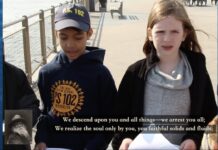
Marine & Ocean Vocabulary. The lyrics of Manhattan Menhaden are displayed in a scrolled format, helping students to learn new words about sea life in the harbor. Scarlet introduces the term “oceanography”, the study of marine ecosystems, surface weather, and global underwater physics. Within a few swim strokes of the Verrazzano Narrows, readers are immersed in Scarlet’s neighborhood of the Lower Harbor and the New York Bight. This microcosm provides definition of the surrounding ocean biology. Scarlet witnesses human progress and modernization, both above and below the waterline. Are fish and marine mammals aware of these changes too? From Scarlet’s perspective, our Manhattan Menhaden story depicts today’s interaction among species that call New York Harbor home. One can’t help but notice a multicultural flavor that casts a broad net over New York’s many cultural communities, enjoying and relying on the bounty of the sea.
Sustainable Fishing Practices. Scarlet talks of fishing responsibly as a credo to which future generations of humankind should and must adhere. Scarlet anticipates a time in the near future when, once again, harvest oyster beds bring a bounty to seafood markets. In raising awareness of local communities, we learn about the Sandy Ground Historical Society on Staten Island. Generational families of fisherfolk continue celebrating their heritage. In the fishing song, Chantymen sing their traditional chorus as they net the plentiful menhaden fish, the favored food choice of whales. Wali, a teenage Humpback whale, is too excited chasing the menhaden into the harbor to realize a container ship is about to cross his path. Scarlet polices the marine activity from her perch on Verrazzano Rock, and in customary fashion, both advocates limited-catch practices as well as rescues Wali from danger.
Strikingly Beautiful Graphics. Richly detailed and colorful AI-generated images enhance the story of Scarlet’s adventures, and provide students with a look at the specialized structures and marine-focused construction projects found in and around New York Harbor.
Inspiration for Maritime Careers. These introductions to waterway projects can stimulate students’ interest in oceanography, but also in environmental protection, marine biology, or marine engineering as a future vocation choice. NYC Department of Education encourages students with a passion for marine related subjects to attend the NYC Harbor School, a high school curriculum tied directly to internship studies under the auspices of the Billion Oyster Project. Beyond scientific pursuit, many students have gone on to achieve degrees or certification in fields related to underwater technical careers, navigation, and piloting.
Song #2. Scarlet Meets The Hudson Canyon Scientists
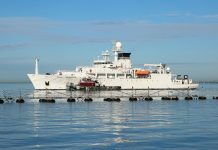
A Very Deep, Dark Dive.Scarlet’s second adventure finds her at a unique location, one hundred miles south of New York City. Here is a marvel of the Atlantic Ocean where deep water coral abound in mystifying cavernous walls. In completely dark conditions, finding and photographing new marine species is the scientific objective of a recent submersible vessel exploration conducted by the National Oceanic and Atmospheric Administration federal agency, also known as “NOAA.”
Ocean Floor Topography. The surprising diversity of marine species is characterized by the varying depth zones of the Hudson Canyon. New York just celebrated the historic, centennial exploration of the canyon in 1925 by the famed oceanographer, William Beebe. Beebe’s bathysphere team never actually completed a full descent, but they roughly calculated the canyon’s sea floor to be approximately two miles deep. Today, NOAA’s submersible vessels have reached the canyon floor. Among its numerous organizational divisions, NOAA is responsible for seafloor mapping as well as assembling teams of scientists on ships specially outfitted with underwater drones or ROV’s (remotely operated vehicles) deployed for exploration projects.
DNA-Driven Species Investigation. Scarlet is fascinated by mankind’s pursuits in the ocean waters of the New York Bight. We hear her issue a call to all of us, “Fish need your help, they sit scared behind kelp!” In search of new species, the NOAA scientists hypothesize, based on comparative DNA from other deep sea discoveries, certain species exist in the Hudson Canyon that are similar to species in other parts of the world, such as the Monterey Bay Marine Sanctuary in California.
Marine Sanctuary Protection. Recent proposals and studies that present sound reasons for Marine Sanctuary protected status have, so far, been denied. However, NOAA as a federal agency, is allowed to continue environmental advocacy projects, still funded by the current administration which appears to favor underwater oil and gas exploration over conservation and protections of the ocean.
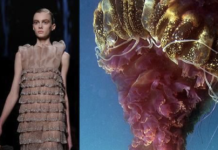
NOAA Fisheries and New Species Identification. As a result of the underwater studies for Marine Sanctuary Designation, collected species have been brought to Washington, D.C. for identification and classification. An abundance of species existing in the dark, deep habitats remain unclassified. Scarlet joins the expedition to the bottom of Hudson Canyon, accompanying the ROV in search of sea cucumbers. NOAA efforts remain elusive in many cases. Exactly how Scarlet’s and Wali the Whale’s clever techniques to nudge the ROV cameras to the very site where their elusive, pink cucumber friend can be discovered remains a mystery. Indeed, Scarlet leaves the question unanswered as she coyly asks the audience, “What do you think they did?!” in the final line of her song.
. . . . . . . . . . .
Song #3. Scarlet Joins The Coastal Resiliency
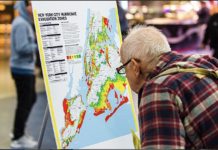
Responses to Hurricanes & Flooding. Scarlet’s third adventure is a wake-up call to the world’s elevated sea level. New York City is not alone in the need to secure its shoreline from storm surge. Oyster reefs once served as New York Harbor’s natural tidal surge barrier. But as the reefs disappeared in recent decades, devising alternative structures became a topic of urgency. Ever since Hurricane Sandy in 2012, the construction of unobtrusive floodgates and high-tech barriers have gone up in harborside NYC parks and playgrounds. Construction is still in progress. NOAA’s climate predictions have prompted government emergency response procedures, equipment, and structures to combat anticipated tidal surge and high water events. Climate change is reflected in marine data with new measurements that warn of flooding over shorelines that will produce similar catastrophic damage equal to or surpassing Hurricane Sandy. The NYC budget for storm prevention is exceeding $20 billion in construction initiatives. From Verrazzano Rock, Scarlet takes on a daunting new role, as NYC’s foremost marine meteorologist for coastal communities, above as well as under the Harbor.
An Organic Approach to Storm Surge. The Living Breakwater, just feet off the South Shore of Staten Island, is New York’s latest concrete oyster reef. With juvenile or seed oyster “spat” tenderly raised by the Harbor School students who volunteer their time in conjunction with the Billion Oyster Project, the reef will form a thriving marine community. This reef re-creation establishes a natural line of defense that serves as a wave barrier protecting the fragile shoreline and the residential neighborhoods adjacent to it, especially in times of hurricanes. With help from Olly the Oyster, Scarlet guides students through the physical structure of the underwater oyster reef support system. Olly cries of “Climate Change!” highlight how rising sea levels adversely affect the existence and vigor of the oyster reef. The playful animation of the underwater shellfish community encourages students to better understand the complex interaction of living organisms that populate a reef.
Plus, Iron & Steel Resiliency. Careful studies of the low-lying areas by the NYC Department of Design and Construction/DDC identified sensitive zones in urban areas that abut the NYC waterfront. Here, nothing short of iron and steel structures will repel strong wave surge. To achieve protection from destructive flooding, critical infrastructure is the priority. As a result, massive flood gates have been delicately integrated into public parkland space. With activation of the series of walls and gates, waves lapping from the harbor will be effectively contained.
Office of Emergency Management (OEM). In the middle of the hurricane, Scarlet is is alerted to a “metal grind” near one of the storm gates of downtown New York and is drawn into fixing a brief structural malfunction. Routine planning between dozens of federal and defense agencies coordinate with city departments, all remaining vigilant while waiting and watching weather predictions and events. The Coastal Resiliency handoff from planning and construction to supervision and management has occurred. OEM maintains office space where specialists are responsible for device activation of this hidden walled fortress that surrounds downtown Manhattan and Brooklyn. Man-made structures are designed to work under the most strenuous weather conditions. However, in a rare mishap, Scarlet, along with Danni the Dolphin, finds herself working alongside underwater experts to resolve an unforeseen operational malfunction.
Overseeing A Symbiotic Relationship. As the unofficial New York Harbormaster, Scarlet has the awesome responsibility to manage mankind’s initiatives with the natural clockwork of marine species. No doubt, the essential and healthy interaction between humans and marine life inhabitants found in and around New York Harbor is more than enough inspiration to keep Scarlet engaged as Harbormaster. Students will learn the importance of honoring and protecting life below the waterline. Her Coastal Resiliency adventure features Scarlet’s active involvement with two linked approaches to storm mitigation.
. . . . . . . . . . . . .
Song #4. Scarlet Discovers The Bubble Curtain
Clean Energy Generation. Scarlet’s fourth adventure returns her to the New York Bight where New York City’s own offshore wind farm is currently in development, 15 miles southeast of Far Rockaway beach. Underwater power lines have already been laid that run to the distribution terminal at Sunset Park in Brooklyn. Despite federal setbacks aimed at eliminating these alternative energy projects, Empire Wind is in the final stage of constructing 54 individual wind turbines. Offshore wind power provides a global, clean energy solution, without the severe physical and chemical damage to the sensitive ocean floor caused by oil and gas drilling.
Features of Offshore Wind Farms. One day, Scarlet’s friends alert her to the presence of unusual ships, temporary platforms, and incredible underwater activity in the nearby Bight. What she finds is a miraculous, inventive use of simple, scientific physics to ensure the safety and wellbeing of marine mammals whose habitat and their very preservation of life cannot be tampered with.
As viewers follow Scarlet into the Wind Farm lease area, they immediately become immersed in the tech-heavy underwater project. Students learn about the planet’s need for new alternative energy production and New York’s creation of infrastructure that will deliver energy to its residents and businesses that historically used only oil and gas.
Construction Noise Minimized. Scarlet is immediately drawn to the offshore construction site with its presence of unusual ships and equipment. She is thrust into the pressing issue of noise reduction from wind farm construction. This becomes Scarlet’s new mission. Students are introduced to scientific terminology such as “passive acoustic monitoring.” Scarlet’s findings point out other private agencies such as the Woods Hole Oceanographic Institute that deploy and maintain buoys in the New York Bight to specifically monitor marine mammal migration and activity. The bubble curtain effectively provides a calming effect that helps quiet even the toughest skeptics among those that fear harm to marine life.
. . . . . . . . . . . . . . . . .
Within the songbook collection of Scarlet the Mermaid’s adventures, students get an exciting glimpse and gain a deeper understanding of the everyday marine life and activities that typify New York Harbor. The collection will likely foster new curiosity about ship traffic, or the maritime professionals who are always on the ready working on contingency plans or building marine infrastructure. Or, about how the need for alternative energy solutions is increasingly in demand. In each story, Scarlet is hard at work, acting with courage and compassion — heroically serving as the underwater New York Harbormaster — and giving students a front row seat to a magical ocean world seldom visited.
We suggest parents, teachers, librarians and program facilitators view the videos on a large screen in a classroom setting to take in the full experience of the rich visuals and scrolled lyrics. Discussion after each song will support age appropriate scientific topics to engage each student with their thoughts and opinions of the subject matter. Please contact NYHC to furnish the series to department heads as we are available to offer in-school lectures. The general public is welcome to view the first song at no charge and the series is available on most screening platforms. We look forward to hearing from you!
AD:
Custom progamming, database and system support
Best custom computer programming, database and system work. https://custom-software-usa.com Custom Software USA